See for more details "About HCCH".
The term "Hague Conference on Private International Law" refers to the name of the intergovernmental organisation, whose purpose is "to work for the progressive unification of the rules of private international law" (Article 1 of the Statute of the Hague Conference). The principal method used to achieve this goal consists in the negotiation and drafting of multilateral treaties, which are called "Hague Conventions".
Between 1893 and 1904 the Conference adopted seven international Conventions, all of which have been subsequently replaced by more modern instruments. From 1951 to 2007 the Conference adopted 38 international Conventions. Until 1960 the Conventions were drafted only in French; since then they have been drawn up in French and English. Among the texts which have been the most widely ratified should be mentioned the Conventions on civil procedure, on service of process and on taking of evidence abroad, the Convention Abolishing the Requirement of Legalisation for Foreign Public Documents, the Convention on the Conflicts of Laws Relating to Testamentary Dispositions, the Conventions dealing with maintenance obligations, the Convention on the Recognition of Divorces and Legal Separations and the Conventions on the protection of minors, on the Civil Aspects of International Child Abduction, and on intercountry adoption. Some of the Hague Conventions deal with the determination of the applicable law, some with the conflict of jurisdictions, some with the recognition and enforcement of foreign judgments and some with administrative and judicial co-operation between authorities, and some combine one or more of these aspects of private international law.
N.B.: Not all Conventions concluded at The Hague are Conventions of the Hague Conference on Private International Law (e.g. the Hague Conventions of 1964 relating to a Uniform Law on the International Sale of Goods (ULIS) and relating to a Uniform Law on the Formation of Contracts for the International Sale of Goods (ULF)).
The Permanent Bureau is the secretariat of the Hague Conference. Its main task consists in the preparation and organisation of the Plenary Sessions and the Special Commissions. The officials of the Permanent Bureau must be of different nationalities. For more information on the entire staff of the Permanent Bureau, click here.
The Permanent Bureau carries out the basic research required for any subject that the Conference takes up. It also maintains and develops contacts with the National Organs, experts and delegates of Member States and the Central Authorities designated by the States Parties to the Hague Conventions on judicial and administrative co-operation, as well as with international organisations and, increasingly, responds to requests for information from users of the Conventions (lawyers, notaries, officials, companies, journalists, private persons, etc.). See also Articles 4 and 5 of the Statute of the Hague Conference.
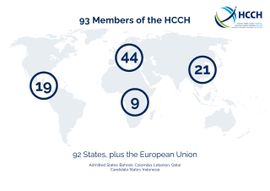 The Hague Conference has currently 93 Members: Albania, Andorra, Argentina, Armenia, Australia, Austria, Azerbaijan, Belarus, Belgium, Bosnia and Herzegovina, Brazil, Bulgaria, Burkina Faso, Canada, Chile, China, People's Republic of, Costa Rica, Croatia, Cyprus, Czech Republic, Denmark, Dominican Republic, Ecuador, Egypt, El Salvador, Estonia, European Union, Finland, France, Georgia, Germany, Greece, Guatemala, Honduras, Hungary, Iceland, India, Ireland, Israel, Italy, Japan, Jordan, Kazakhstan, Korea, Republic of, Latvia, Lithuania, Luxembourg, Malaysia, Malta, Mauritius, Mexico, Monaco, Mongolia, Montenegro, Morocco, Namibia, Netherlands, New Zealand, Nicaragua, Norway, Panama, Paraguay, Peru, Philippines, Poland, Portugal, Republic of Moldova, Republic of North Macedonia, Romania, Russian Federation, Rwanda, Saudi Arabia, Serbia, Singapore, Slovakia, Slovenia, South Africa, Spain, Sri Lanka, Suriname, Sweden, Switzerland, Thailand, Tunisia, Turkey, Ukraine, United Kingdom of Great Britain and Northern Ireland, United States of America, Uruguay, Uzbekistan, Venezuela, Viet Nam and Zambia.
See Article 2 of the Statute of the Hague Conference.
The First Session of the Hague Conference on Private International Law was convened in 1893 by the Netherlands Government on the initiative of T.M.C. Asser (Nobel Peace Prize 1911). Prior to the Second World War, six Sessions were held (1893, 1894, 1900, 1904, 1925 and 1928).
The Seventh Session in 1951 marked the beginning of a new era by the preparation of a Statute which made the Conference a permanent intergovernmental organisation. The Statute entered into force on 15 July 1955. Since 1956, regular Plenary Sessions have been held every four years. In case of need, as occurred in 1966 and 1985, an Extraordinary Session may be held.
The Plenary Sessions discuss and adopt the draft Conventions (and sometimes Recommendations) prepared by the Special Commissions and take decisions on the subjects to be included in the agenda for the Conference's work. All of the texts adopted are brought together in a Final Act which is signed by the delegations. Under the rules of procedure of the Plenary Sessions each Member State has one vote. Decisions are taken by a majority of the votes cast by the delegations of Member States which are present at the vote. Non-Member States invited to participate on an equal footing with Member States also have the right to vote.
Under a tradition which has been followed since the First Session, the President elected for the Plenary Session has always been the leading Delegate of the Netherlands.
The Seventeenth Session marked the Centenary of the Conference and was held from 10-29 May 1993. The Eighteenth Session held in October 1996 adopted the Convention on Jurisdiction, Applicable Law, Recognition, Enforcement and Co-operation in Respect of Parental Responsibility and Measures for the Protection of Children and decided to institute a Special Commission charged with drawing up a draft Convention on the protection of adults.
The Nineteenth Session adopted, in December 2002, the Convention on the Law Applicable to Certain Rights in respect of Securities held with an Intermediary. In June 2005, the Twentieth Session adopted the Convention on Choice of Court Agreements. In November 2007, the Twenty-First Session adopted the Convention on the International Recovery of Child Support and Other Forms of Family Maintenance and the Protocol on the Law Applicable to Maintenance Obligations.
From time to time, Special Commissions are held at The Hague to monitor the practical operation of Hague Conventions, including the Hague Service and Evidence Conventions, the Hague Child Abduction Convention and the Intercountry Adoption Convention.
See Article 8 of the Statute of the Hague Conference. See also under Projects.
Thereafter, for each State ratifying, accepting or approving it subsequently, or acceding to it, the Convention enters into force three months after the deposit of instruments of ratification, acceptance or approval or accession (cf. e.g. Art. 46 (2a) of the 1993 Adoption Convention).
N.B.: Not all the Hague Conventions follow the general rule explained above. Hence, to obtain a reliable answer here, each Convention must be verified separately. You can do so by clicking on Conventions and then consulting the Final Clauses of the particular Convention you are interested in.
According to the Hague Conference's terminology, ratification is, in general, reserved for Member States exclusively. There are, however, some exceptions. These include the Convention of 22 December 1986 on the Law Applicable to Contracts for the International Sale of Goods, which is open for signature and ratification by all States with no distinction, and the Convention of 29 May 1993 on Protection of Children and Co-operation in Respect of Intercountry Adoption, which is open for signature and ratification by all States that have participated in the Seventeenth Session.
The Vienna Convention on the Law of Treaties of 23 May 1969 gives the followings descriptions:
Article 2 - Use of terms
1. For the purposes of the present Convention:
(...)
(f) 'contracting State' means a State which has consented to be bound by the treaty, whether or not the treaty has entered into force;
(g) 'party' means a State which has consented to be bound by the treaty and for which the treaty is in force;
(...)
By signing a Hague Convention, a State expresses, in principle, its intention to become a Party to the Convention. However, signature does not, in any way, oblige a State to take further action (towards ratification or not).
Ratification involves the legal obligation for the ratifying State to apply the Convention. According to the Hague Conference's terminology, ratification is, in general, reserved for Member States exclusively. There are, however, some exceptions. These include the Convention of 22 December 1986 on the Law Applicable to Contracts for the International Sale of Goods, which is open for signature and ratification by all States with no distinction, and the Convention of 29 May 1993 on Protection of Children and Co-operation in Respect of Intercountry Adoption, which is open for signature and ratification by all States that have participated in the Seventeenth Session.
Others States wishing to become a Party to a Hague Convention may accede. This, however, is only possible once the Convention has entered into force. The States that are already Parties to the Convention must in some cases accept this accession. This system of acceptance varies from one Convention to another: some Conventions provide for a system of tacit acceptance (if there is no opposition over a certain period of time; see e.g. Art. 58 (3) of the 1996 Convention on Jurisdiction, Applicable Law, Recognition, Enforcement and Co-operation in Respect of Parental Responsibility and Measures for the Protection of Children), whereas others require express acceptance by the States Parties to the Convention (see e.g. Art. 38 (4) of the 1980 Convention on the Civil Aspects of International Child Abduction). It should be noted that the Convention of 22 December 1986 on the Law Applicable to Contracts for the International Sale of Goods provides that every State (including Member States of the Conference) may accede to this Convention.
The column "Res/D/N" (= Reservations, declarations, notifications) provides a link to the relevant information for that State, which also shows the articles under which the reservation or declaration has been made.
Where you see a figure in the column "Ext", the corresponding State has extended the Convention to its territories. Clicking that figure will lead you to the table of extensions. This table shows to which territories the application of the Convention has been extended, the dates of these extensions and the dates of entry into force of the Convention for these territories, as well as any declarations or reservations that may have been made, and authorities that may have been designated for these territories. There is also, for some Conventions only, a table of acceptances of extensions available.
First click on "Conventions" in the left-hand navigation menu and select the Convention you are interested in. Then press the button "Status table" in the right-hand navigation menu.
Where you see A* in the column "Type", the accession of the corresponding State has been accepted by other States. Clicking "A*" will lead you to the table of acceptances of the accession. This table shows which Contracting States have accepted the accession, the dates of the acceptances and the dates of entry into force between the acceding State and the accepting States.